
Saving a Mulberry Whale !

I
n 2008, Les Amis du Pont Bailey were able to save a Bailey Bridge in Normandy.
This was supposedly the last surviving vestige of the colossal Battle of Normandy in 1944 which led to the liberation of France and Western Europe.
The campaign to save this historic bridge was difficult and required the help of hundreds of French and British supporters for a few crucial months.
The result is that a 27 ton Bailey Bridge which had been condemned to 'death' in July 2008 was alive and well, three months later, sitting peacefully beside the river Vire at Pont-Farcy as a memorial to all those who helped to liberate Normandy.
But was this really the last vestige of the Battle of Normandy?
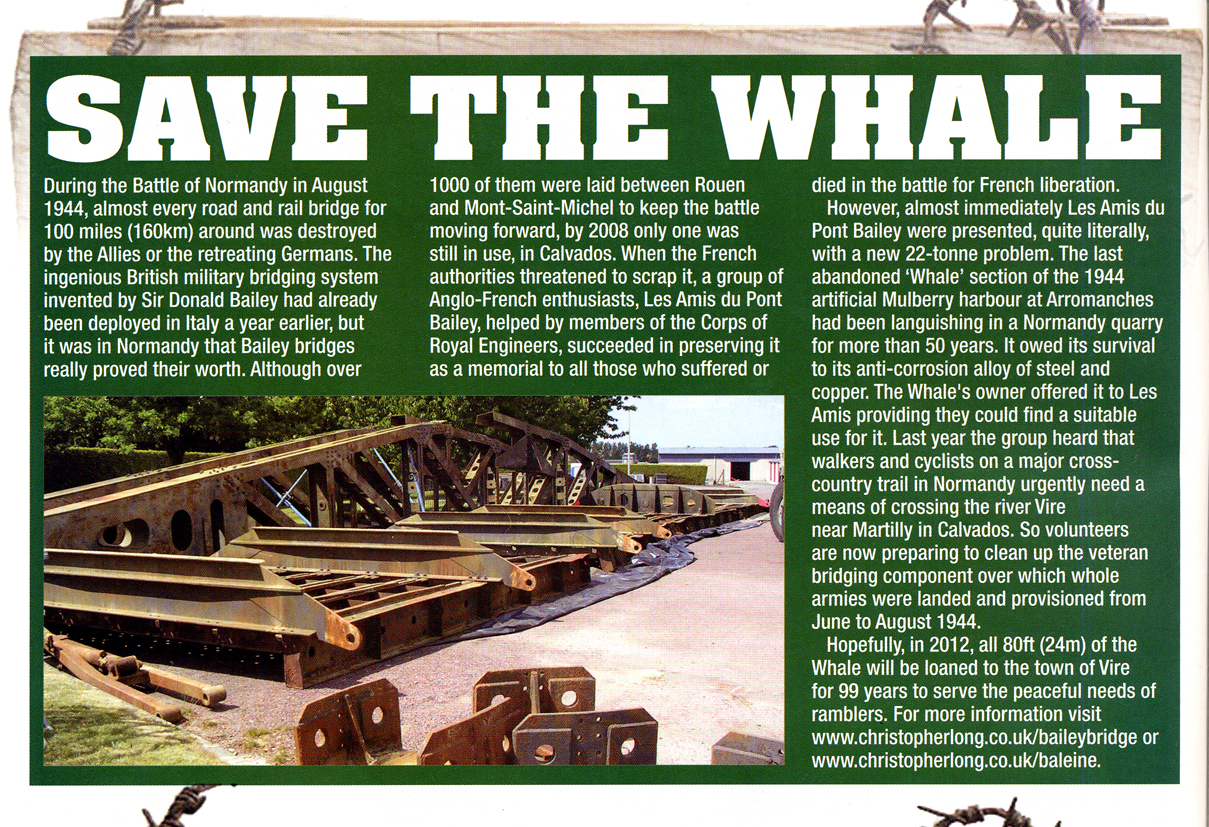
Apparently not, because just as Les Amis du Pont Bailey were celebrating the survival of their Bailey Bridge, they were offered the opportunity to save a 27 ton of the floating roadway from the 1944 artificial harbour, Mulberry 'B', at Arromanches.
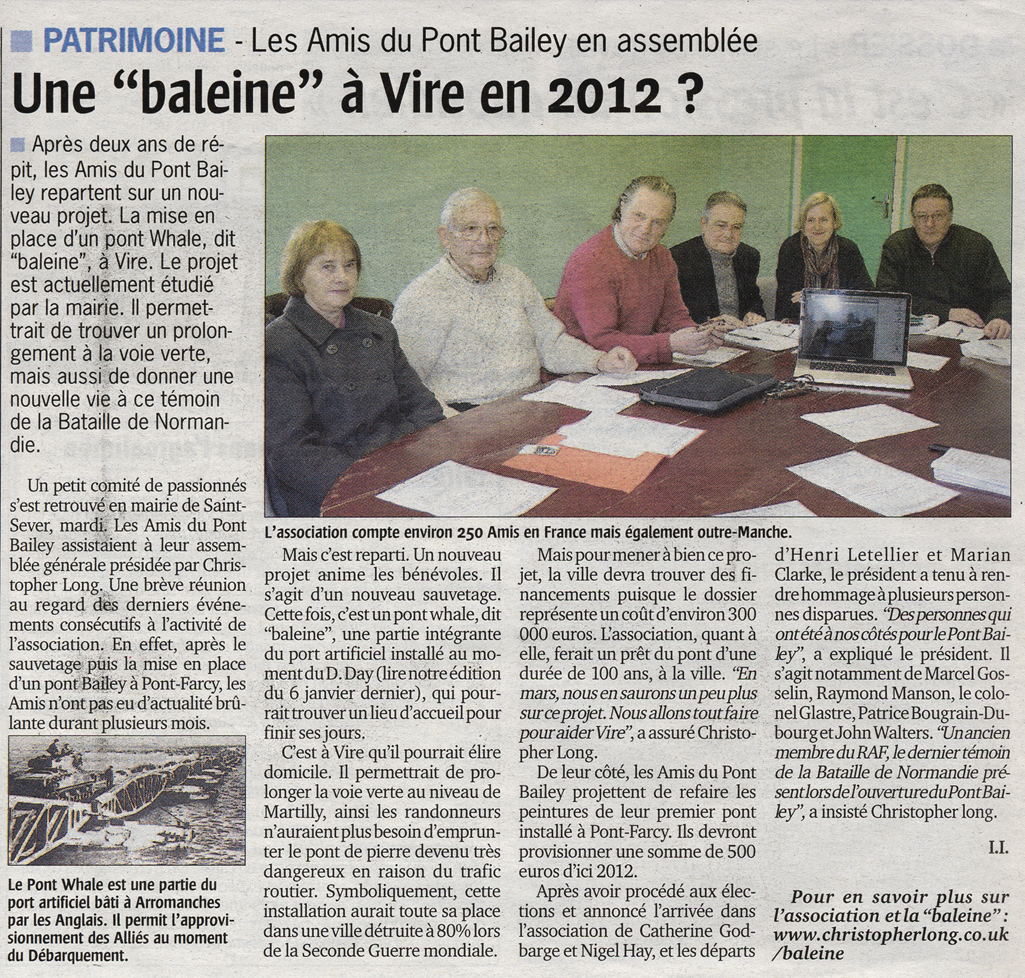
La voie verte a Vire à besoin d'un pont... et voilà qu'un pont idéal a été mis à la disposition de la Ville de VIRE...
C'est un Whale (une baleine), rare élément clé du port artificiel d'Arromanches, un des deux ports construits par les Anglais pour l'approvisionnement des Alliés au moment du Débarquement du 6 juin 1944.
La mise en œuvre de ce Whale, dernier témoin de la Bataille de Normandie, nous permettrait d'assurer en toute sécurité le passage des randonneurs et cyclistes.
Elle donnerait également un atout touristique de premier plan à cet ouvrage à caractère historique et pratique, digne du souvenir de la Libération de Vire et de la France.
L'association Les Amis du Pont Bailey (association de Loi 1901) s'engage à mettre à disposition ce pont à la Ville de VIRE pour 99 ans. L'ouvrage est en très bon état mais il reviendra à la Ville de VIRE de trouver le financement pour l'installer et le rendre fiable.
En janvier 2012 le coût du projet était estimé à 220 000 € financé à hauteur de 50% par des subventions: dont 33 000 € par la Région, 30 000 € par le Département du Calvados et 50 000 € par Leader+.
La bonne réutilisation d'un vieux pont...
L'exemple de St Denis de Méré dans le Calvados...

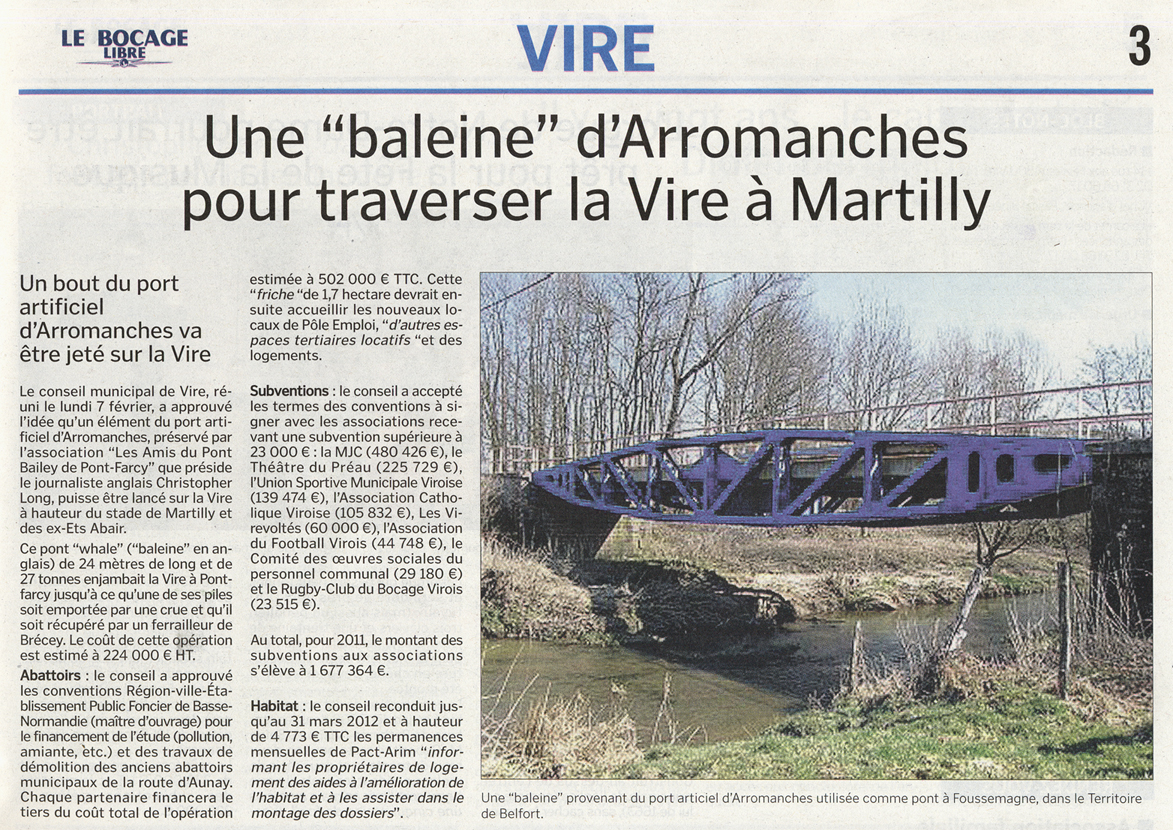
 Située non loin de Pont d'Ouilly, près de Berjou en Basse-Normandie, la minuscule commune de Saint-Denis-de-Méré posséde un pont insolite qui attire en permanence des milliers de visiteurs. C'est le Pont des Bordeaux, réalisé à partir d'un 'Whale', l'une des centaines d'éléments de la chaussée flottante du port de 'Mulberry B' bâti par les Anglais à Arromanches en 1944, un ensemble de 24.43 mètres de long et de 22 tonnes.
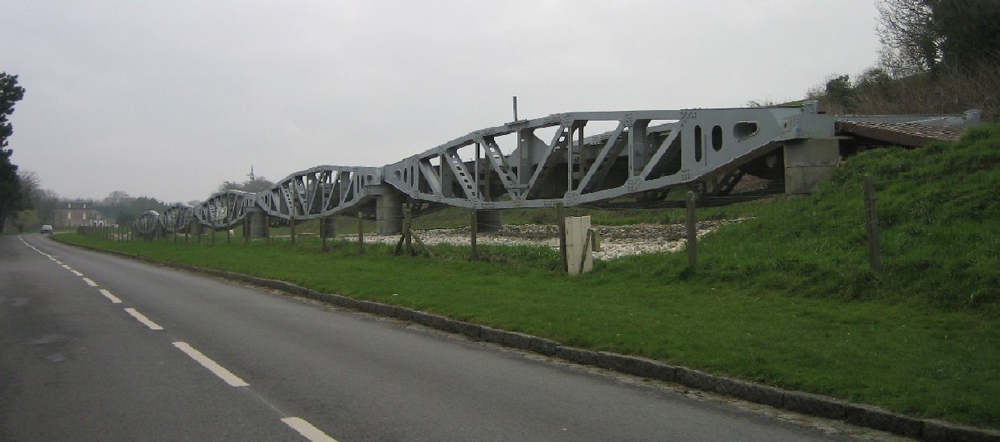
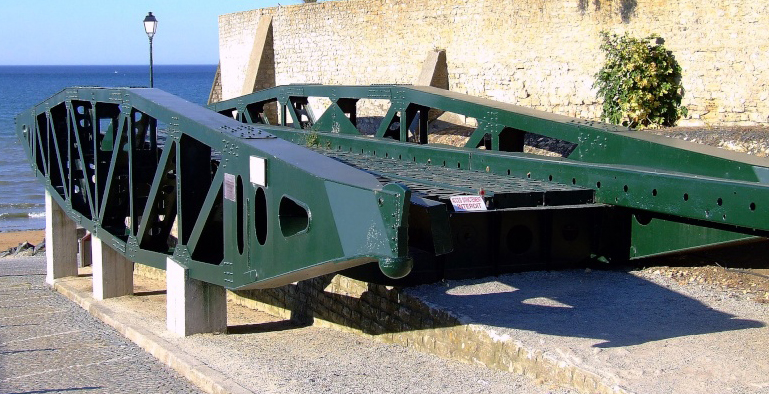 Ce port artificiel conçu sur les ordres de Churchill par des ingénieurs britanniques a traversé la Manche juste après le débarquement du D-Day et a contribué à rendre possible la Bataille de Normandie.
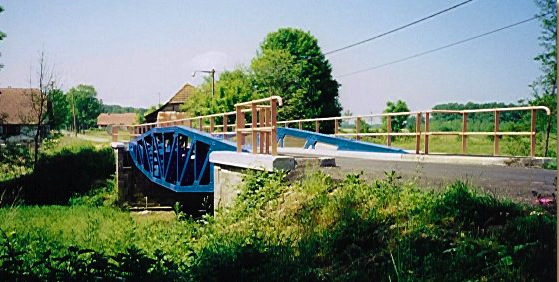 La structure qui est arrivée à Saint-Denis-de-Méré en 1945 était venue remplacer un pont détruit pas la résistance francaise et a été restaurée par la commune en 2002 avec l'aide du Conseil Général du Calvados.
Ce pont reste non seulement bien préservé et bien entretenu, mais un panneau placé à proximité permet d'en connaître les origines et l'histoire.
The history of the Pont-Farcy 'Whale'...
1944

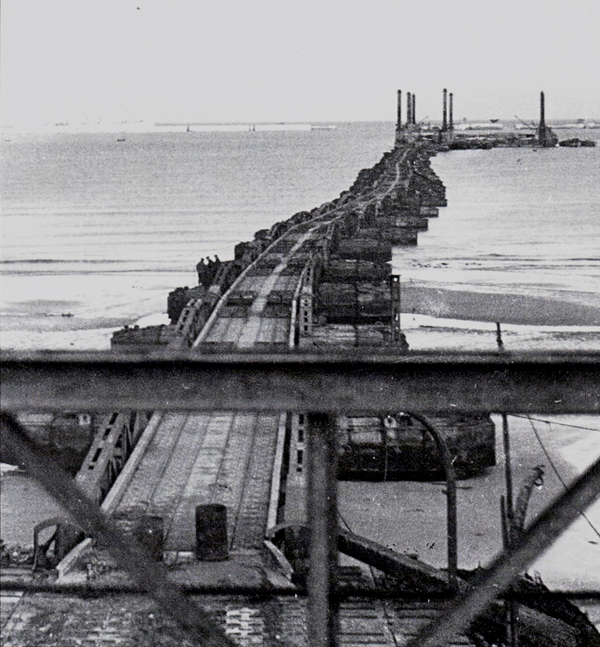
 In 1944 this Whale was an element in one of the three extraordinary floating roadways linking the artificial harbour with the beaches at Arromanches.
British engineers had designed and built two harbours which were towed in pieces across the Channel and then assembled off the Normandy coast three days after the D-Day landings.
Mulberry 'A', destined for the Americans at Omaha, was virtually destroyed during a violent storm on 19th June. Mulberry 'B' at Arromanches, survived the storm and served British needs from June to August 1944 (still operational in November 1944).
The idea of liberating occupied Europe by towing these ports in kit-form to the French coast came directly from British prime minister Winston Churchill on 30 May 1942.
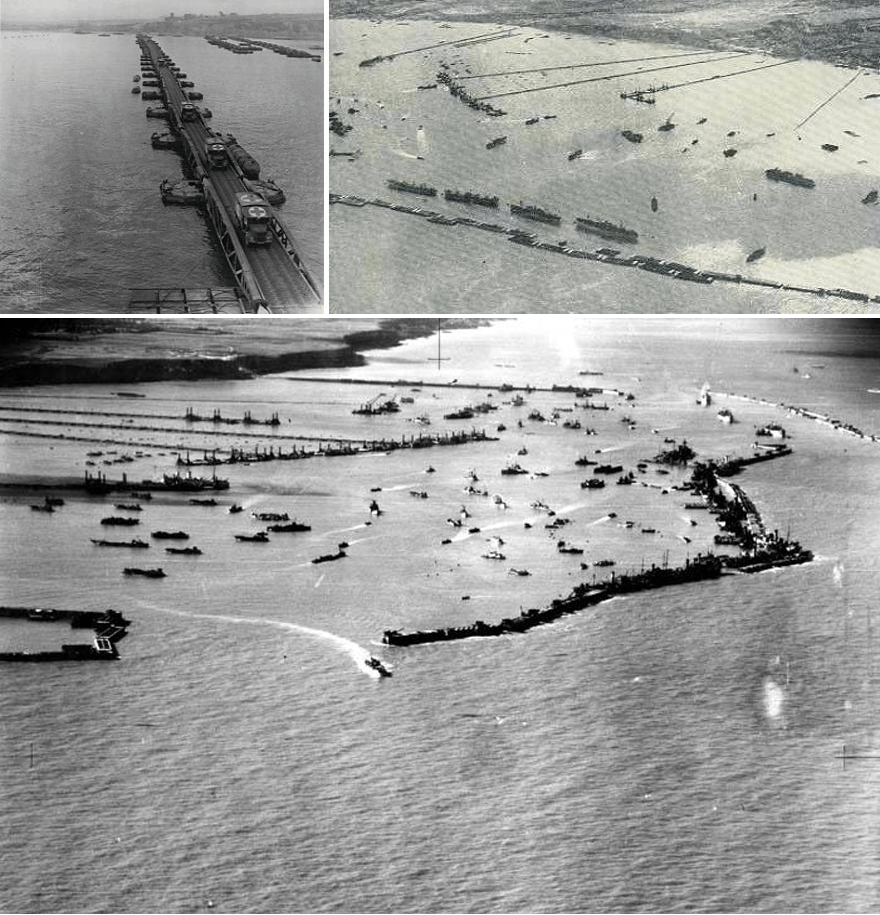 Six months later the United States entered the war in the west and planning for a joint British-American-Canadian invasion could begin.
Designed by British engineers, the two gigantic harbours were built in 1943-44 in total secrecy by 50,000 workers in hundreds of construction yards throughout the British Isles. Each consisted of 600,000 tons of concrete with 33 jetties linked by nearly 16 kms of floating roadway.
The harbour wall, about 9 kms long, consisted of 146 'caissons', each weighing 6,000 tons and the equivalent of five-storey buildings.
In the ten months following D-Day, 2,500,000 men, 500,000 vehicles and 4,000,000 tons of supplies passed through the Arromanches harbour, destined for British, Canadian and French forces. When liberated, Cherbourg increasingly served American needs.

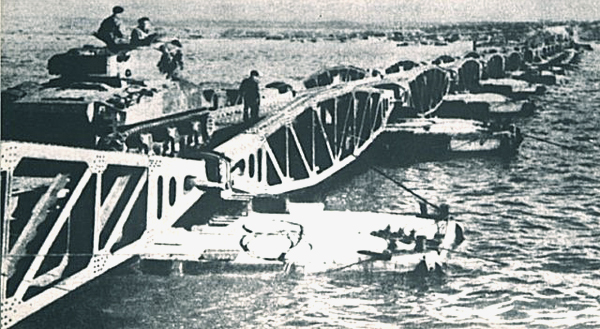 As the Allies moved on towards Berlin and the liberation of Western Europe, many military Bailey bridges and elements of the artificial harbours were used to replace hundreds of road and rail bridges destroyed during the Battle of Normandy. The last of these, a Bailey bridge, was saved for posterity by Les Amis du Pont Bailey in 2008. Some Whales were also re-used, including one at St Denis-de-Méré and another at Pont-Farcy...
After 1945
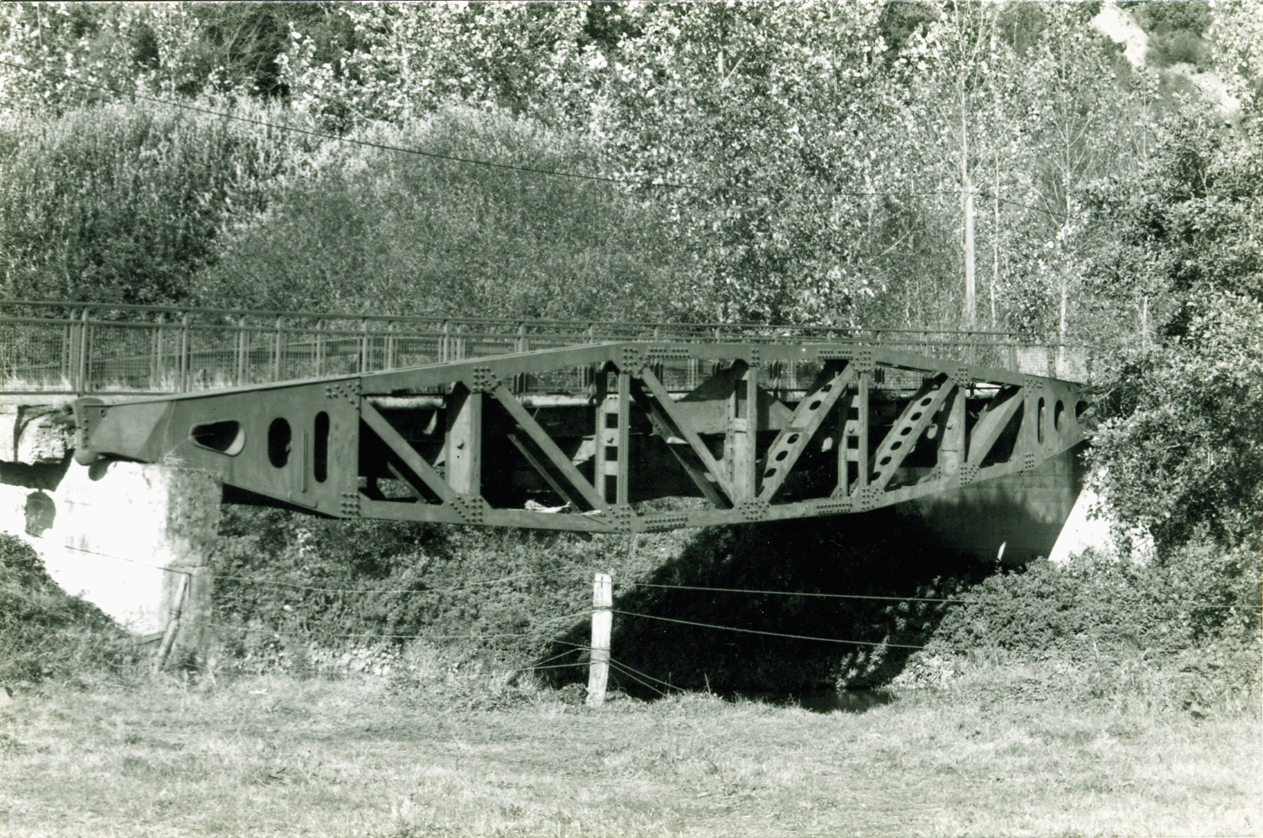
 No one can remember exactly when this Whale was brought to Pont-Farcy from Arromanches. It may have been in 1958 that the Robbe quarry at La Grippe needed direct access across the river Vire to the main road leading to Vire & St Lô. Both these mediaeval towns had been severely damaged by almost indiscriminate high-altitude American bombing during the Battle of Normandy (June-August 1944). The quarry at La Grippe was among those which supplied huge quantities of stone for the rebuilding of hundreds of Norman towns, as well as their local infrastructure. [Neighbouring Fourneaux acquired its Bailey bridge (now preserved at Pont-Farcy) in 1958 following an initiative by a local conseiller général who "went to Arromanches to get it". Almost certainly the quarry owner (M. Robbe) or the town council of Pont-Farcy took a similar initiative at about the same time, choosing a redundant Whale from Arromanches.]
1990


 For more than 30 years the Whale served the needs of Pont-Farcy's quarry at La Grippe as well as residents of nearby Beau Costil and neighbouring Fourneaux. In 1990, however, severe flooding of the river Vire caused damage to the concrete pier supporting the western end of the Whale. Sadly, the value, history and significance of this Whale was either forgotten or ignored by Pont-Farcy's town council when a contractor was employed to get rid of it. A great debt is owned to Monsieur Claude LOISEL of LTP Loisel SA who chose not to sell the high-grade steel for scrap. Instead he stored it in his quarry at Brécey awaiting an opportunity to see it restored and put to good use.
2008

 In August 2008, the Norman ornithologist Jean COLLETTE saw what he thought might be a Bailey Bridge at the Loisel quarry and contacted the president of Les Amis du Pont Bailey. The ornithologist had discovered a very rare Whale!
[ The Bailey bridge : By October 2008, after three months of work, Les Amis du Pont Bailey had succeeeded in preserving the last remaining WWll Bailey bridge in Calvados. It had served the Mulberry 'B' artificial harbour at Arromanches but from 1958, it had been used to bridge the river Vire between Pont-Farcy and Fourneaux. By 2008 it was threatened with destruction. ]
In August 2008 Monsieur LOISEL was sufficiently impressed by the Bailey bridge campaign to offer his 'Whale' to the president of Les Amis du Pont Bailey, Christopher LONG, provided that the association could find a suitable location for it.
2010
 VIRE lies almost halfway along the major voie verte that runs from Carentan (near the American wartime landing beaches) to Mont-Saint-Michel in the south-west. A bridge over the river Vire near Martilly was urgently needed to provide a safe crossing point for walkers and cyclists.
[ Appropriately it was near this point that liberating British and American troops met on either side of the river Vire in the first week of August 1944. By 2 August, in the final stages of the British 'Operation Bluecoat', British troops based at Bény-Bocage had liberated La Graverie, La Papillonère, Neuville and Vaudry and secured the eastern approaches to the town. They had even sent patrols into the almost undefended town of Vire itself. On 5 August the Americans liberated the western approaches and were ordered to occupy the town (which by now was much more strongly defended by the Germans) while British forces moved eastwards to Condé-sur-Noireau, Flers and Falaise. ]
On 27 April 2010, Les Amis du Pont Bailey responded positively when Catherine GODBARGE asked whether the Whale might provide an ideal solution. Following various site meetings and an inspection of the Whale itself, Jean-Bernard PEZERIL (Vire's director of Technical Services) was appointed to manage the project and prepare a proposal and budget.
2014

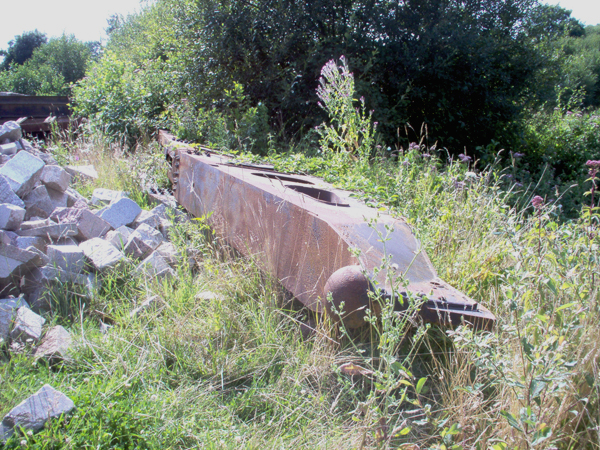
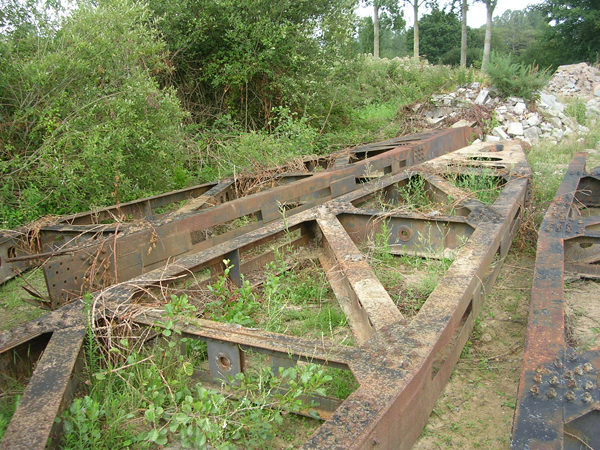
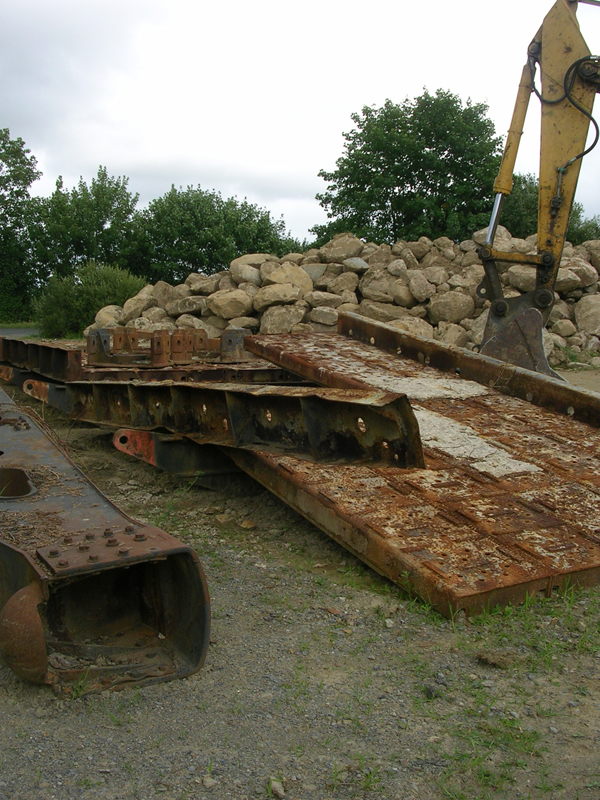
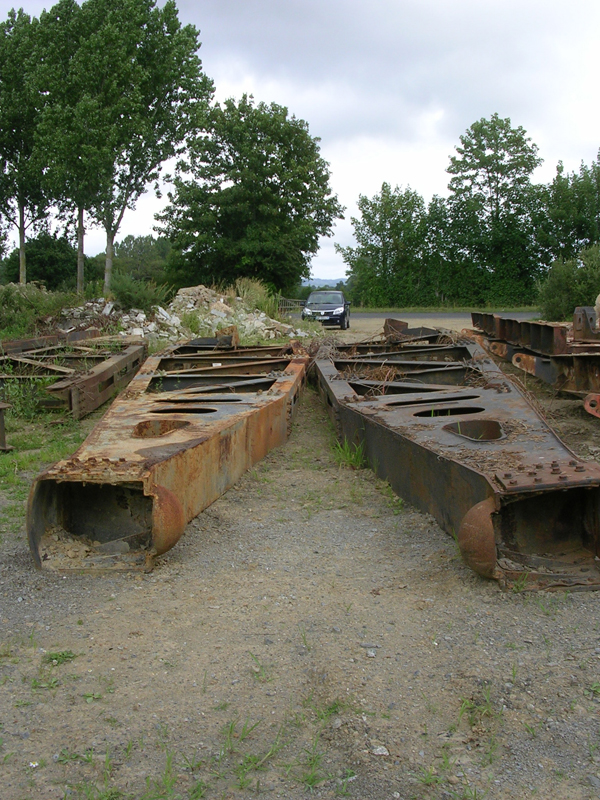
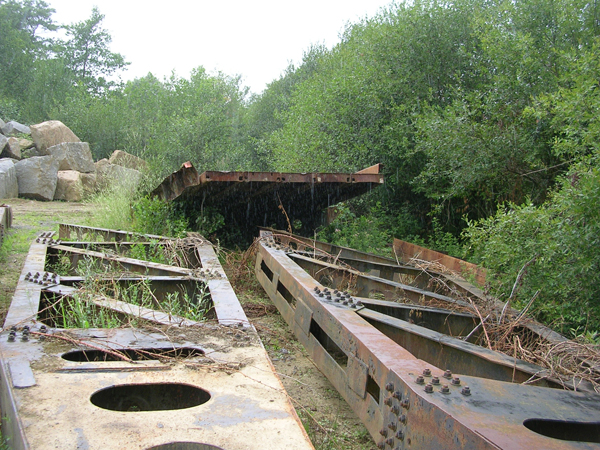
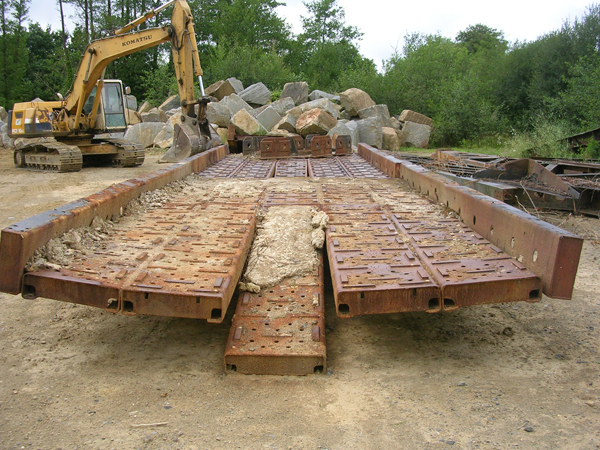
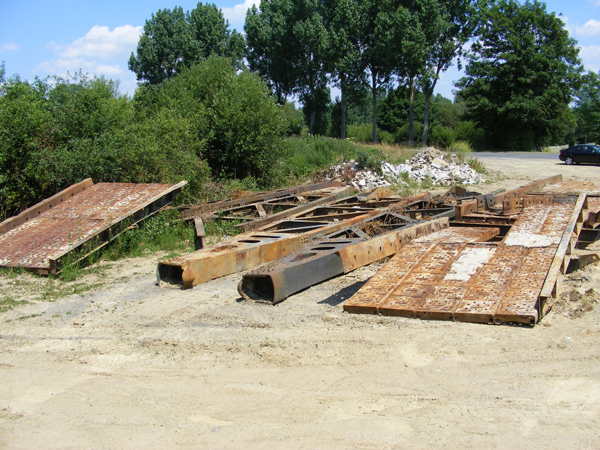
Les éléments du Whale avant restauration...





Vire, ville fondamentale
à la Libération de la Normandie en 1944...
 Cliquez sur les images pour les voir plus grandes.
During the first two months of the Battle of Normandy (June and July 1944) British troops were frustrated in their efforts to take Caen and break out towards Falaise. Similarly the Americans were bogged down in the northern half of the Cotentin peninsula.
At the end of July, however, the British launched Operation Bluecoat (29 July – 5 August) which was intended to protect the American left wing and draw the most powerful German panzer divisions away from the American front.
The results were spectacular. The Americans were indeed able to break out towards Avranches (Operation Cobra) but, unexpectedly, within a week, the British had punched their way through the bocage as far south as Vire and taken control of the main east-west road across Normandy upon which all German hopes of advance or organised retreat depended.
Almost every road and rail bridge in Manche and Calvados had been destroyed either by Germans to slow the Allied advance or by the Allies to prevent the Germans escaping. Hundreds of these military bridges, designed by the British engineer Donald Bailey, were built all over Normandy in 1944. Today, the Bailey bridge at Carentan, Manche, is still in use. Another, the Pont-Farcy Bailey bridge was still in use as a road bridge in 2008. Today it is preserved by Les Amis du Pont Bailey as a memorial to the Liberation and all our liberators.
This British advance towards Vire (from Caumont-l'Éventé, to St Martin-des-Besaces and Le Bény-Bocage) exhausted Germany's panzer divisions and assured the Americans a clear run into Brittany and the Mayenne.
On the 2nd August 1944 British troops had occupied Vaudry, La Papillonère and Neuville around the north of Vire and even sent patrols into the town itself which was found to be almost empty and undefended. Albert Miclon and his son Guy, watching from Vire railway station, saw British troops heading for Vire via Martilly and later saw them returning from the centre of the town.
 However, General Montgomery chose to please the Americans by allowing them the honour of occupying the town. The British were ordered to turn east to secure the road and towns between Vire and Falaise. By the time the Americans arrived, three days later, Vire had been heavily reinforced and defended. Sadly this mediaeval town was 80 per cent destroyed by artillery and air bombardments prior to the Americans' successful night attack on the 5/6th of August.
As the Americans began clearing rubble in the streets of Vire and moving south to secure the Vire/Mortain road, British troops had seen three days of bloody action against Panzer troops to secure Estry, Perrier Ridge (La Pavée see Sidney Bates V.C.) and the hillsides to the north of Viessoix. Having won control of the road from Vire to Conde-sur-Noireau, the way was open to push the Germans back to Pont d'Ouilly, Flers, Putanges and the Falaise 'gap'.
VIRE LIBÉRÉE EN AOÛT 1944 : Si la Bataille de Stalingrad avait marqué le début de la fin des ambitions allemandes en Russie, la bataille pour Vire, plus modeste bien sûr, a marqué néamoins le début de la fin des ambitions allemandes en France. La courte contre-attaque dans les Ardennes apart, le parcours des Allemands consistait d'une retraite continue jusqu'à l'outre-Rhin.
LA VILLE DE VIRE AUJOURD'HUI : a la possiibilité de se servir d'un rare survivant du port artificiel d'Arromanches qui a lui-même fait possible la Bataille de Normandie. Ce Whale permettrait à la ville d'assurer en toute sécurité le passage des randonneurs et cyclistes sur la voie verte qui longe la rivière. Il donnerait également un atout touristique de premier plan à cet ouvrage à la fois historique et pratique, mais digne aussi du souvenir de tous ceux, de toutes nationalités, qui ont risqué – et souvent perdu – leur vie, leur santé et leur liberté pour la Libération de la France.
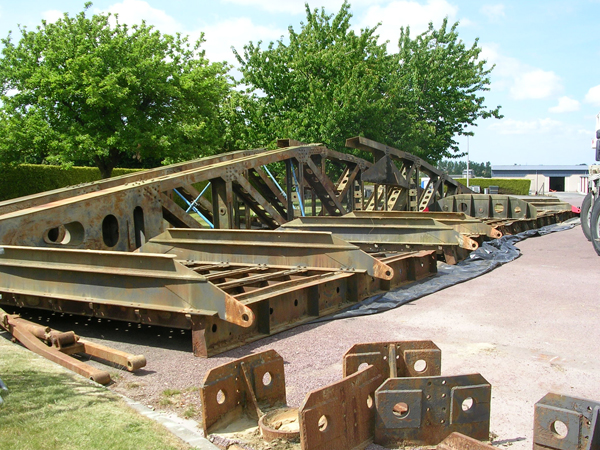
Spécifications techniques d'un Whale (baleine)...
Longeur : 24.43m ; hauteur : 2.43m ; largeur : 4.19 (centres) 5.00m ; poids: 27 tonnes.
Cliquez sur les images pour les voir plus grandes

- On 27-04-2010 Catherine Godbarge, deputy mayor of Vire, approached Les Amis du Pont Bailey to ask whether the Whale was still available and whether it might be used as a bridge across the river Vire for walkers and cyclists at Martilly.
- On 03-06-2010 Les Amis du Pont Bailey met Catherine Godbarge and Jean-Bernard Pezeril to look at another Whale road bridge at St Denis-de-Méré and then visited the proposed site at Martilly, near Vire.
- On 01-07-2010 members of the committee of Les Amis du Pont Bailey made a site visit to the Whale at the LTP Loisel SA quarry at Brécey to assess its suitability. This meeting was attended by two of Vire's town councillors, including Catherine Godbarge, as well as Jean-Bernard Pezeril who declared the structure to be in good condition and suitable for use as a bridge.
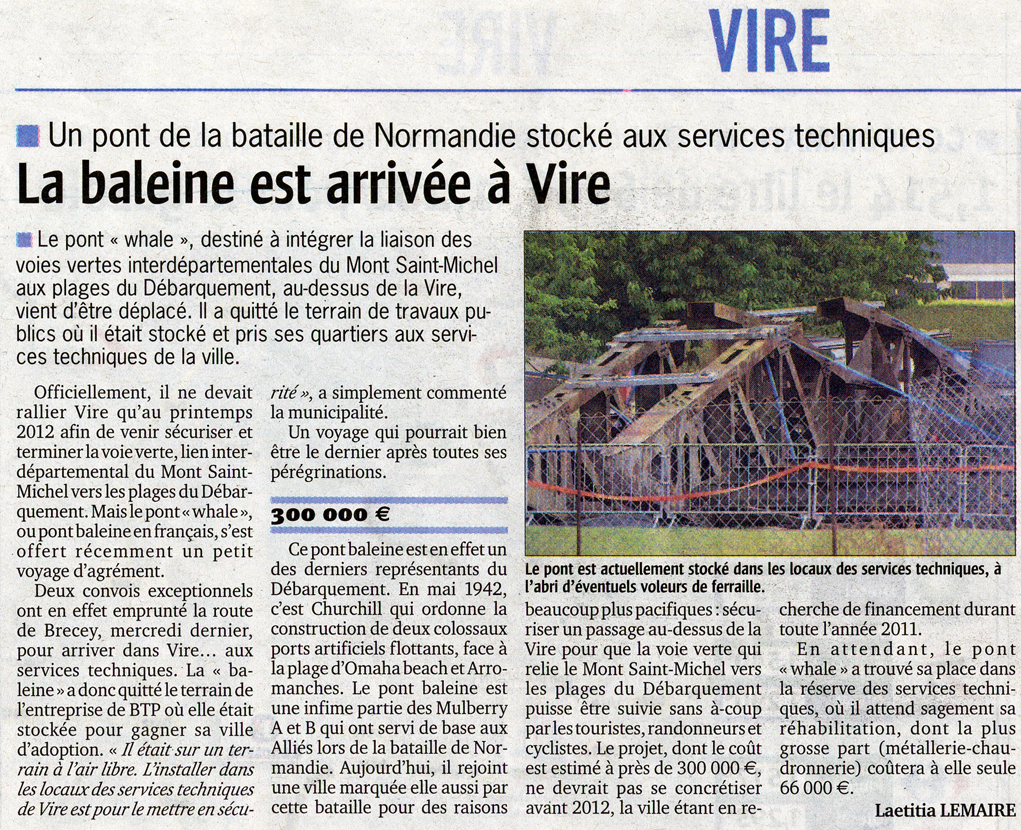
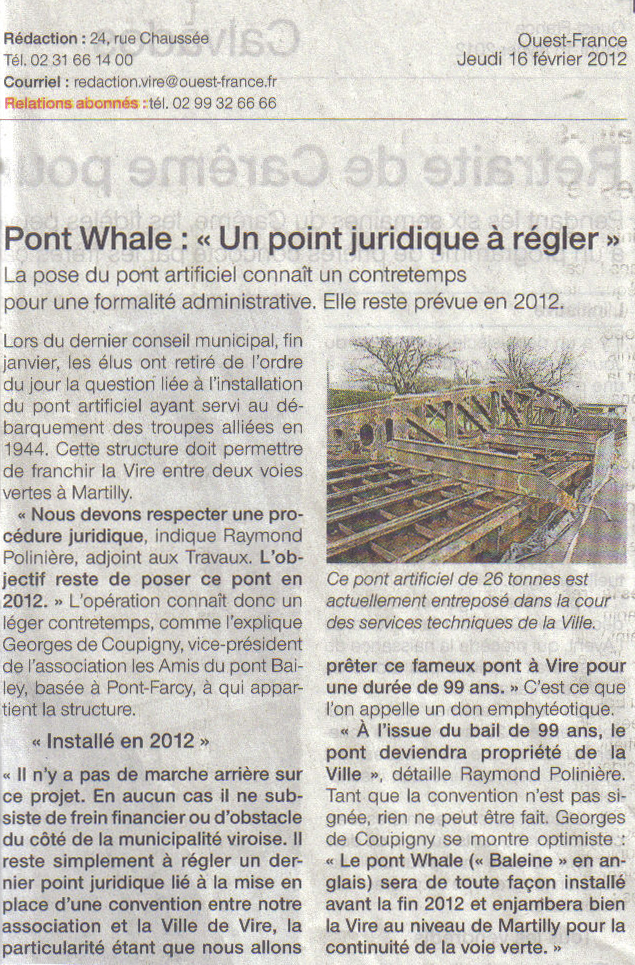
- On 01-06-2011 the Whale was transported on two low-loaders from a quarry in Brécey (Manche) to the Services Téchniques depot in Vire (Calvados) where the various elements were secured preparatory to a major restoration programme.
- On 10-10-2011 members of the committee agreed at a meeting with J-B Pezeril and Catherine Godbarge that they would organise a series of Anglo-French volunteer working parties, starting in mid-November, to dismantle parts of the structure in order to reduce costs and allow sand-blasting and paint-work to take place during the winter.
- On 03-11-2011 Nigel Hay and Christopher Long assembled tools and coated as many bolts as possible with diesel in order to loosen them in preparation for a first full-scale working party on 09-11-2011.
- On 08-11-2011 Christopher Long and Catherine Godbarge met Monsieur Philippe at the mairie in Vire to discuss a contract determining the future ownership/loan of the Whale.
- On 09-11-2011 a party of volunteers spent a day at the Services Téchniques in Vire dismantling all eight elements of the Whale's floating roadway assembly. Thanks to a combination of brute strength, a powerful compressor and a range of old, non-standard Whitworth spanners, at least 150 heavy-duty bolts were unscrewed so that the town's engineering department can now separate, move and start sand-blasting the roadway sections. The volunteers included: Nigel Hay, Kenneth Lewis, Bill & Jacqueline Twohigg, Christopher & Sarah Long and Pierre Gobichon. L'Abbé Yves Langlois and Michel Manson came to offer encouragement and the team is most grateful to Jean-Bernard Pezeril, Didier and Samuel for all their help on site. A reporter from La Manche Libre also came to watch the start of the restoration progress.
- On 12-11-2011 A group of members of the APB visited the Musée du Débarquement at Arromanches in order to see in detail how the Whales were assembled and used in June/July 1944.
- On 12-12-2011 Catherine Godbarge and CAL prepared a letter to M. Claude Loisel concerning the formal transfer of ownership of the Whale to the APB.
- On 06-01-2012 Ownership of the Whale was formally transferred to the APB when Catherine Godbarge and CAL met M. Claude Loisel at LTP Loisel (Brécey) who handed over a signed contract generously giving the association the opportunity to preserve the structure in perpetuity.
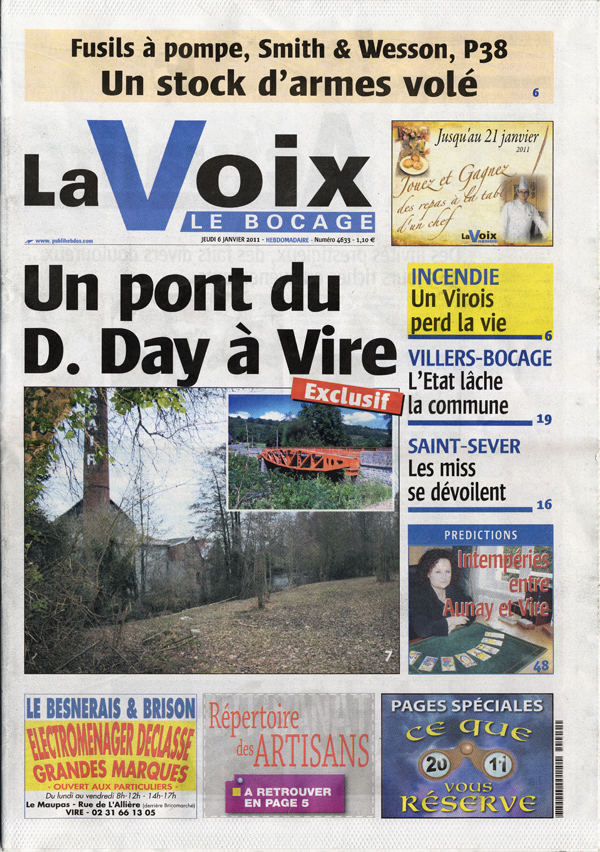
- On 06-01-2011 La Voix Le Bocage reported Catherine Godbarge as saying that funding for the project (estimated at €220,000) was now in place with grants of €33,000 from the Region, €30,000 from the Department and €50,000 from Leader+. An estimated balance of €107,000 would be financed by the municipality.
- On 10-01-2012 an extra-ordinary meeting of the APB committee was held at Coupigny (attended by Georges de Coupigny, Pierre Desjardins, CAL, Sarah Long, Nigel Hay, Jean-Paul Duval and Catherine Godbarge) to discuss the terms on which the Whale would be lent to Vire municipality for a period of 99 years. Catherine Godbarge produced a preliminary contract prepared by Vire's lawyers for discussion alongside a similar list of conditions prepared by CAL. Two much valued APB members, Bill Twohigg and Richard Smith, felt that now was an appropriate time for them to step down as committee members and therefore did not attend.
- On 12-01-2012 CAL met lawyer Virginie Lesourd at Vire mairie to study a contract the town had produced, intending to add to it a handful of conditions which the APB, as the owner and lender, wished to see included. Over the next few days it emerged that the town was unable or unwilling to agree to a single one of the half dozen conditions requested by the APB upon which loan of the Whale would have been based. CAL also discovered that, contrary to everything that had been agreed at the start of negotiations (in 2010-11), the Services Techniques at Vire intended to abandon a large proportion of the original Whale (regarded as unnecessary or not worth restoring).
- On 19-01-2012 CAL stated that the purpose of the APB was to preserve and conserve its Bailey Bridge and its Whale intact. For two years he believed he had been negotiating in good faith with Vire's elected councillors. Instead he found he was negotiating single-handed with a lawyer representing the wishes of a council employee who was only interested in preserving parts of the Whale. It was not the business of the APB to provide the town of Vire with a free steel bridge and under no circumstances was he prepared to sign any contract which would result in the mutilation of a rare and valuable historic structure, a symbol of Anglo-French history and of the sacrifices made during the Battle of Normandy. He noted that of seven other surviving Whales in Normandy, all had been carefully repaired and preserved by their owners and that, although the APB's Whale was an almost intact example, it was now likely to be butchered. Tired and feeling increasingly uncomfortable and alone in his dealings with the Vire Services Techniques he tendered his resignation as President of the APB (asking for this to be ratified at the next AGM on 02-03-2012).
- On 13-02-2012 A committee meeting decided to visit the Services Techniques in Vire to make an inventory of the Whale's parts and to find out exactly what the director's proposals were.
- On 14-02-2012 At a meeting with the director of Vire's Services Techniques, the association's worst fears were confirmed. Georges de Coupigny, Pierre Desjardins, Nigel Hay & Sarah Long heard that the director intended to discard much of the Whale's famous 'floating roadway' as well as the iconic triangular supporting panels on each side of the structure. The association's committee later agreed that this was unacceptable and informed the Services Techniques that they wanted a formal inventory of the Whale's components (completed on 02-03-2012) and would seek independent professional advice on their structural integrity. Meanwhile approaches were made to museums on the Normandy coast to find an alternative home for the structure.
- On 27-02-2012 Georges de Coupigny, Pierre Desjardins, Nigel Hay and CAL witnessed the start of work to separate the Whale's component parts in order make an inventory and assess the quality of each part of the structure. This survey was made by Nigel Hay and Pierre Desjardins on 01/02-03-2012.
- On 02-03-2012 the APB formed a new committee under a new president, Nigel Hay. Christopher Long, the founding president, agreed to continue serving on the committee alongside Georges de Coupigny, Pierre Desjardins, Sarah Long, Jean-Paul Daval, Catherine Godbarge, Jean Collette and Armelle de Coupigny.
- On 17-03-2012 Pierre Desjardins published his detailed inventory of the Whale's components currently stocked at the Services Techniques in Vire.


Above right: This was the Pont de la Souleuvre, near Vire, designed by Alexandre Gustave Eiffel (1832-1923), famous for his Eiffel Tower in Paris. In 1970 the authorities decided to destroy all of its steel railway track – see below...
In 2012 the Whale was at risk of losing its 'floating roadway'.

"At the APB conseil general on 2nd March 2012, we could not persuade our founder and president, Christopher Long, to continue as president for another year.
As an association we owe a huge debt to Christopher for his tenacity in seeing the Pont Farcy Bailey Bridge project to fruition, gently driving the APB along as a friendly and enjoyable associ-ation, but with a serious mission, to save the last wartime Bailey Bridge in Calvados.
His enthusiasm and commitment to the project brought together a group of people, who in most cases didn’t already know each other but who immediately became linked in friendship due to our common interest in saving part of Normandy's heritage.
Our current mission, to save the last of the Arromanches 'Whale' sections is also due to Christopher who saw the urgent need to retrieve this very iconic structure from where it had languished for many years. He built up such an excellent relationship with the quarry owner, Claude Loisel, that the Whale was donated to the society rather than cashed in – a very generous gift at a time when scrap steel prices were very high. For two years (2010-12) Christopher led a project, with the town of Vire, to restore and use the Whale in its entirety as a bridge for walkers and cyclists on the chemin vert route at Martilly.
As an association we are keen to see the Whale in use again, but we have to ensure the integrity of the use of the Whale and that its originality is preserved for future generations.
 — NIGEL HAY
President de l'APB, 15-03-2012.
Press Items









Transporting the 21 tonne Whale from Brécey to Vire 01-06-2011
